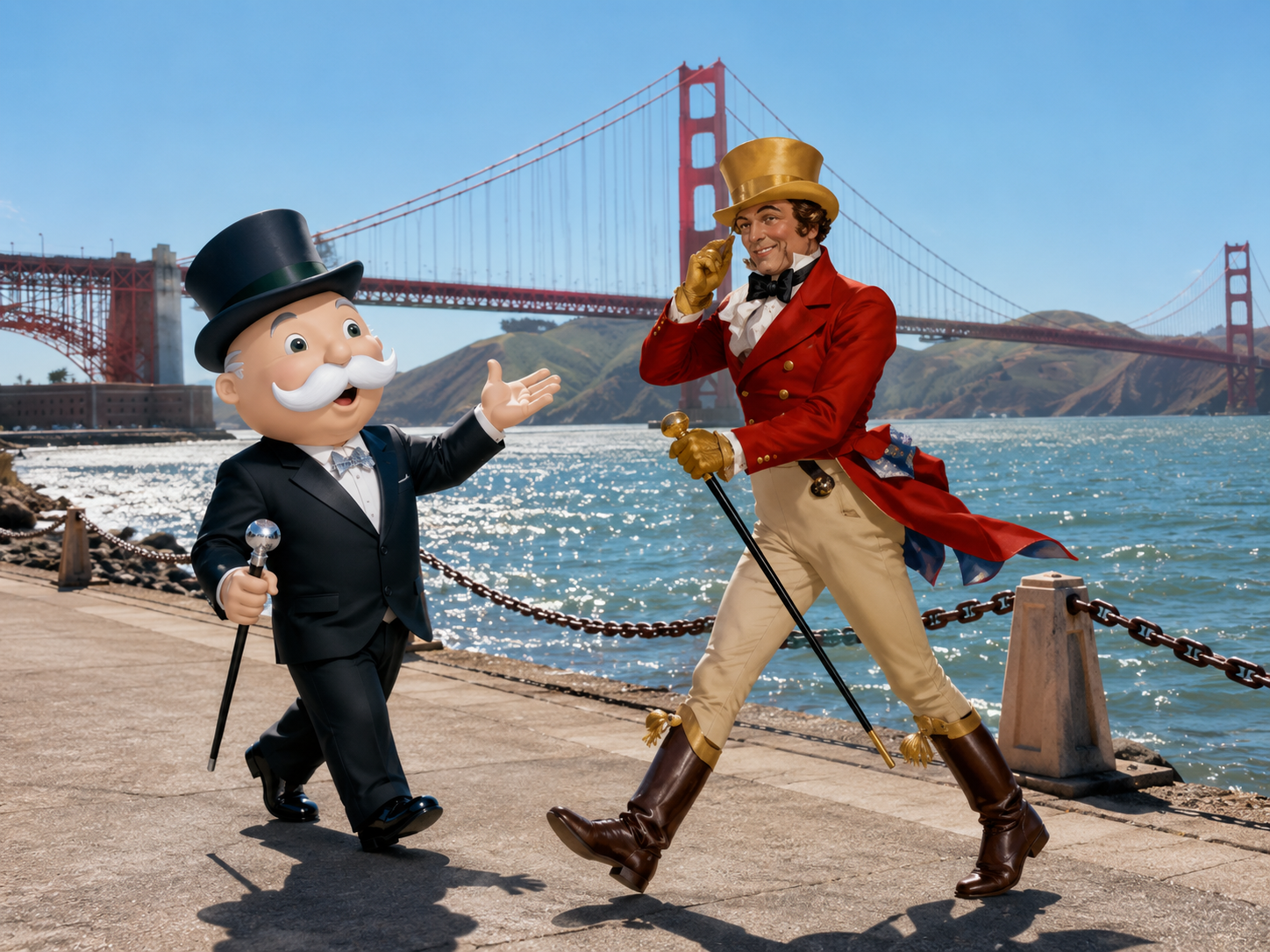
What we have here, ladies and gentlemen, is not a meeting but a confrontation disguised as a stroll — two avatars of the same nineteenth-century costume, finally made to stand in the same frame, and the photograph is honest enough to let their differences do all the talking.
Begin with the hands. Pennybags' palm is open, upturned, presentational — the gesture of a man who has already closed the deal and is simply showing you where to sign. It is the hand of accumulation performing generosity, the eternal salesman's tell. The Striding Man, by contrast, touches the brim of his gilded topper — not an offer but an acknowledgment, the minimal courtesy one gentleman extends to another he recognizes but has no intention of stopping for. One invites you in. The other tips his hat and keeps walking. Between them sits the entire argument we've been building all afternoon: capital that pauses to extract, and capital that never stops long enough to be caught extracting anything at all.
Then the canes — and here the photograph becomes genuinely instructive. Pennybags carries a short, silver-topped stick, unadorned, almost clerical, the accessory of a man who uses it to punctuate a sentence, not to walk any distance. The Striding Man's cane is absurdly long, black-shafted, gold-knobbed, more scepter than support — an object designed to be seen from across a ballroom, not leaned on. Same prop, same century, same class costume, and yet each cane confesses a different relationship to motion: one that stops and counts, one that never arrives and therefore never has to.
The costuming itself deserves its moment of scrutiny. Pennybags is rendered in the flattened, cartoon-adjacent plastic of a mascot who knows he is a mascot — the exaggerated mustache, the too-round face, the comfortable admission that this is a piece of branding wearing a tuxedo. The Striding Man, by contrast, is played entirely straight: a real human face, genuine tailoring, a crimson coat with the theatrical flourish of a ringmaster crossed with a Regency dandy. One character has made peace with being illustration. The other insists on being taken as a person, which is, of course, the more dangerous performance — sincerity is always harder to see through than caricature.
And then the setting, which does something neither figure asked for. The Golden Gate Bridge behind them was raised during the Depression with public financing and public labor — a monument, in brick and cable, to the idea that visible collective hands sometimes accomplish what an invisible one declines to. Both gentlemen parade past it in full costume, canes swinging, hats tipped, entirely unbothered that the bridge at their backs quietly refutes the mythology each of them was built to sell. Pennybags' game teaches that fortunes are made by circling a board alone until your opponents go bankrupt. The Striding Man's slogan insists that progress requires nothing but continuous, untroubled forward motion. Neither mascot has a mechanism for a bridge — a thing built slowly, together, by people who were not, in fact, going it alone.
So here they are: costumed cousins from the same graphic decade, dressed by different tailors to sell different fictions, walking side by side past the one structure in the frame that neither of their economic philosophies can quite explain. It is, in the end, an extremely well-composed photograph of two lies taking a very confident walk — and the bridge, wisely, says nothing, because it has already made its argument in steel.